
Deep Learning
A hands-on course in designing, training, and evaluating deep neural networks (MLPs, CNNs, RNNs, and transformers) in PyTorch, grounded in the math of why they train at all.
Schedule 9
Week 6
Residual connections and normalization
residual connectionsvariancegradient flowbatch normlayer norm
Week 7
Multi-class classification, cross-entropy, and optimizers
cross-entropyJacobiansoptimizerslearning-rate schedulesdropout
Introduces Project 1.
Week 8
Understanding modern activation functions
ReLUsigmoidSiLUgating
What did your MLP learn?
generalizationoverfittingdouble descentdata augmentation
Week 9
Steering what a network learns
inductive biasinvarianceconvolutiondata augmentationdata efficiency
Max pooling is a gate
variance through convs and poolspaddingmax poolingSoftPoolattention pooling
Introduces Projects 2 and 3.
Week 10
The transformer encoder, from the CNN side
softmax poolingattentionmulti-head attentionposition encodingRoPEVision Transformer
Week 11
Cross-attention, foundation models and PEFT
cross-attentionencoder-decoderfoundation modelsin-context learninglinear probingfine-tuningintrinsic dimensionLoRA
Computational processes implemented with neural networks
Thu, Nov 19
GANsself-playdeep Q-learningdiffusionNeRFdifferentiable renderingdifferentiable memorysurrogate gradients
Play the tic-tac-toe DQN: AI4200/week11.2-dqn-tictactoe.ipynb (QR code on the results slide).
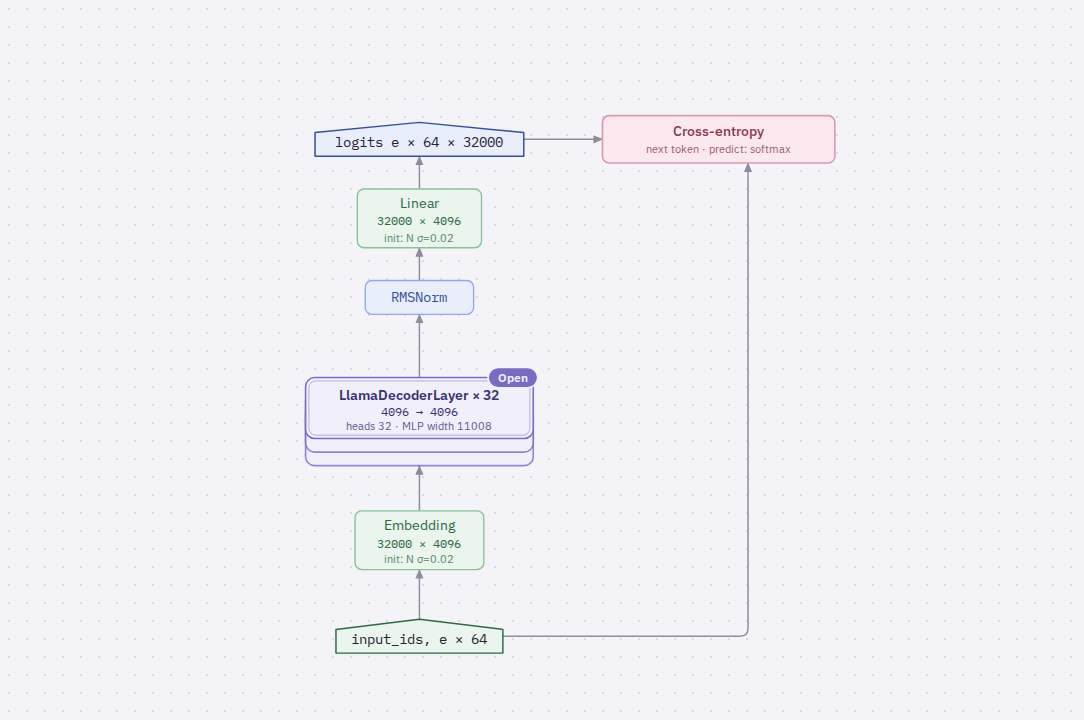
Models to explore in Torch Canvas
About this course
An advanced, practical course in deep learning that pairs the mathematical foundations with the skills to design, implement, train, evaluate, and deploy deep neural networks: MLPs, residual CNNs, RNNs, LSTMs, GRUs, transformers, and more. Coursework is hands-on coding on real-world datasets, using high-performance computing resources. Prerequisite: CSC 4220, Introduction to Machine Learning.
Students will learn to:
- derive and implement backpropagation, and use automatic differentiation and gradient checking;
- understand what makes deep networks trainable: initialization, activation functions, residual connections, and batch and layer normalization;
- choose, build, and train the right architecture for a problem (MLPs, CNNs, RNN/LSTM/GRU, transformers);
- apply regularization, optimizers like momentum and Adam, learning-rate schedules, and hyperparameter tuning;
- use transfer learning, parameter-efficient fine-tuning, and data augmentation;
- build reproducible training pipelines with checkpointing and experiment tracking;
- recognize ethical, safety, and fairness issues in deep learning systems.
Topics. Foundations review · PyTorch · variance and gradient flow · vanishing and exploding gradients · residual connections and normalization · learning-rate scheduling, Adam, and regularization · CNNs, RNNs, and transformers · self-supervised learning, foundation models, and parameter-efficient fine-tuning · representation learning · responsible AI.
Format. Lectures, discussion, and in-class coding; assignments are designed to be done in class. AI assistance isn’t allowed unless an assignment says so, since the goal is being able to build these methods yourself. Grading: assignments 30% · four quizzes 20% · two exams 50%. Students in AI 5200 do extended assignments plus a long-form book reading and discussion.